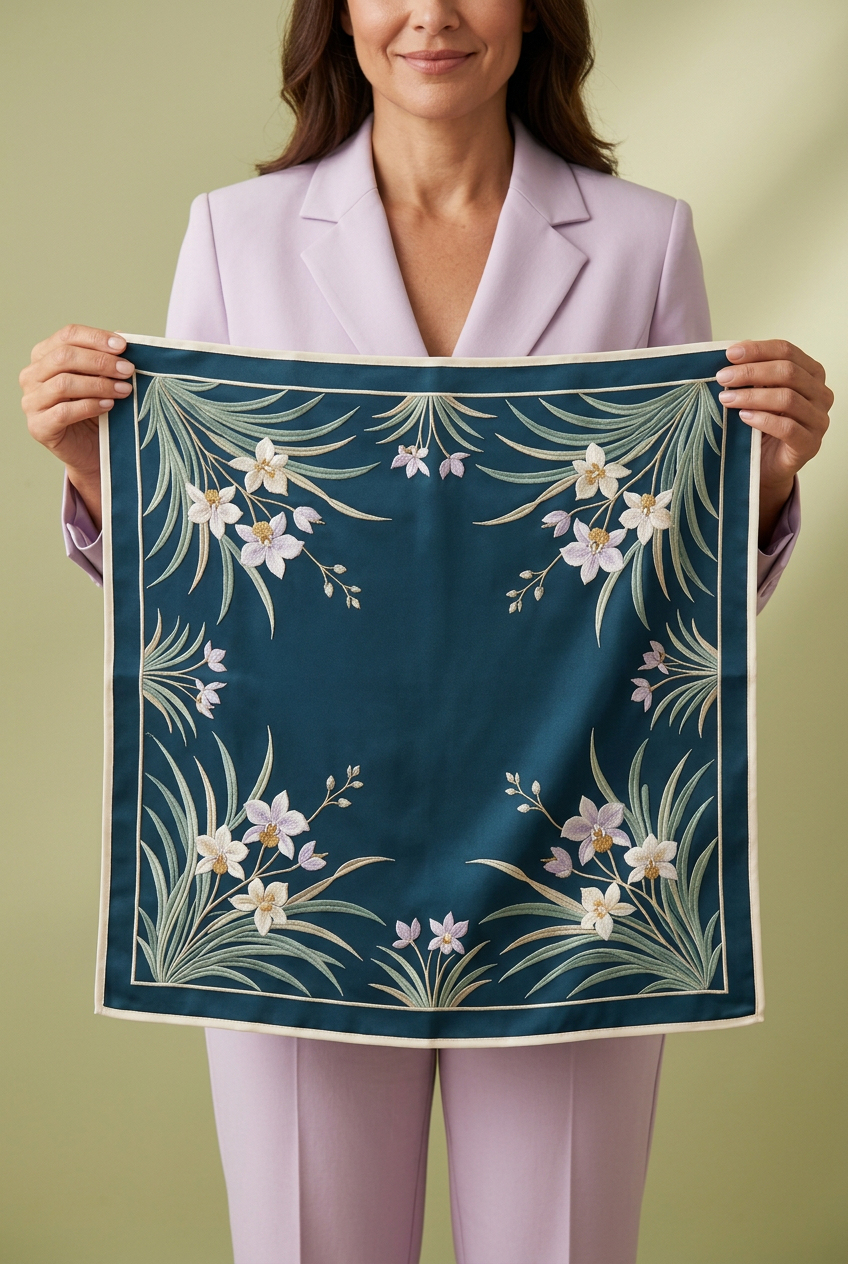
Orchid Reverie Embroidered Square Scarf — Ink Teal with Ivory & Lilac Blossoms, Sweeping Sage Leaves and a Light Border
Orchid Reverie Embroidered Square Scarf — Ink Teal with Ivory & Lilac Blossoms, Sweeping Sage Leaves and a Light Border
Couldn't load pickup availability

🖼️ The beauty is in the frame.
Spread it out, and the composition becomes clear: a deep ink-teal square, a fine light-colored edge and orchids gathering around the perimeter. The middle is quieter, giving the flowers and long leaves room to define the shape rather than filling every inch with pattern.
Orchid Reverie is a Chinese-inspired embroidered square-scarf with a darker, more tonal character than an ivory floral accessory. It brings together pale blossoms, sweeping foliage and a softly lustrous ground, creating interest through contrast and direction rather than bright color alone.
Outside in: three layers of the design.
The edge establishes the outline.
A narrow ivory-colored finish traces the square. Just inside it, a slender champagne-colored line adds another boundary, separating the botanical arrangement from the outermost edge. These two lines give the scarf definition when it is laid flat and provide small light accents when portions of the fabric fold together.
The corners remain square, with no fringe or ribbon-like pointed ends. This changes the way the whole design reads: the floral arrangement belongs to a broad field of fabric, not to two narrow decorated tails.
The leaves create the movement.
Long sage and muted jade leaves sweep inward from the corners. Some follow the outer frame; others curve toward the center before turning back into the surrounding foliage. Their narrow shapes produce a different rhythm from rounded flower petals, giving the border a sense of flowing direction.
The leaves are layered rather than lined up in a simple repeat. Pale highlights and darker green sections distinguish one blade from the next, while fine champagne-colored accents connect them to the warmer flower centers.
The blossoms provide the pauses.
Ivory and pale lilac orchids sit between those longer lines. Their lighter petals become the points where the eye briefly stops before following another sweep of foliage. Small buds add detail at a smaller scale without introducing a separate pattern.
The close-up imagery concentrates on the contrast between the flower shapes and the leaf strokes, along with the raised, thread-like texture of the embroidery. The arrangement is abundant around the borders but leaves the central teal area comparatively open.
💠 A dark ground with more than one mood.
Ink teal sits between a deep blue and a green-toned neutral in the palette. Against ivory clothing, it becomes a clear dark accent. Beside lilac, it gives the lighter color more depth. With charcoal or navy, it produces a quieter, closely related combination in which the pale embroidery becomes more prominent.
The fabric surface appears smooth and softly lustrous in the images. Light follows the folds, creating brighter teal areas beside darker ones. This visual change comes from the pictured lighting and drape; it is not evidence of a particular fiber, fabric weight or performance characteristic.
A wardrobe study in two settings.
Consider a cream blouse and taupe trousers, the kind of combination that already feels complete without a pattern. Hold the scarf against those colors and the ivory flowers connect with the blouse while the teal introduces a deeper note. The botanical border supplies the decorative detail without asking the entire outfit to change.
Now place it beside pale lilac tailoring. The orchid petals create a direct color relationship, but the teal prevents the result from becoming uniformly pastel. The sage leaves remain a quieter third element, adding variation without needing a matching green accessory.
For an evening direction, try a simple charcoal top and restrained jewelry. The ivory border and flowers become the clearest highlights. For daytime, ivory, sand and muted gray keep the palette lighter while leaving the scarf as the main color statement.
Let the final measurements guide the styling.
A square format invites folding experiments, but neck, hair and bag-accessory uses should be assessed only after the finished dimensions and fabric behavior are confirmed.
If exploring a fold on a finished sample, pay attention to which part of the border remains visible. A change in orientation can emphasize either the pale blossoms or the longer leaf lines. The open center offers a quieter section of color, while the corners carry the denser botanical detail.
From full view to fine detail.
- The white-background photograph shows the complete square outline and border placement.
- The orchid close-up focuses on the blossom colors, leaf lines and stitch-like relief.
- The corner detail illustrates the edge finish and inner frame.
- The drape image shows the transition between the open center and embroidered border.
A coordinated, unbranded presentation.
The packaging direction uses a plain ivory box with dark teal ribbon, continuing the collection's visual language without a printed logo. A folded view allows one embroidered corner to introduce the design before the square is opened.
No claims are made of hand embroidery, double-sided embroidery, hand-rolled edges, machine washability or colorfastness. Champagne and gold-toned refer to colors rather than precious-metal thread.
A dark square, a light border and a garden arranged around the edges. Sometimes the most expressive part of a design is the space it chooses to leave open.